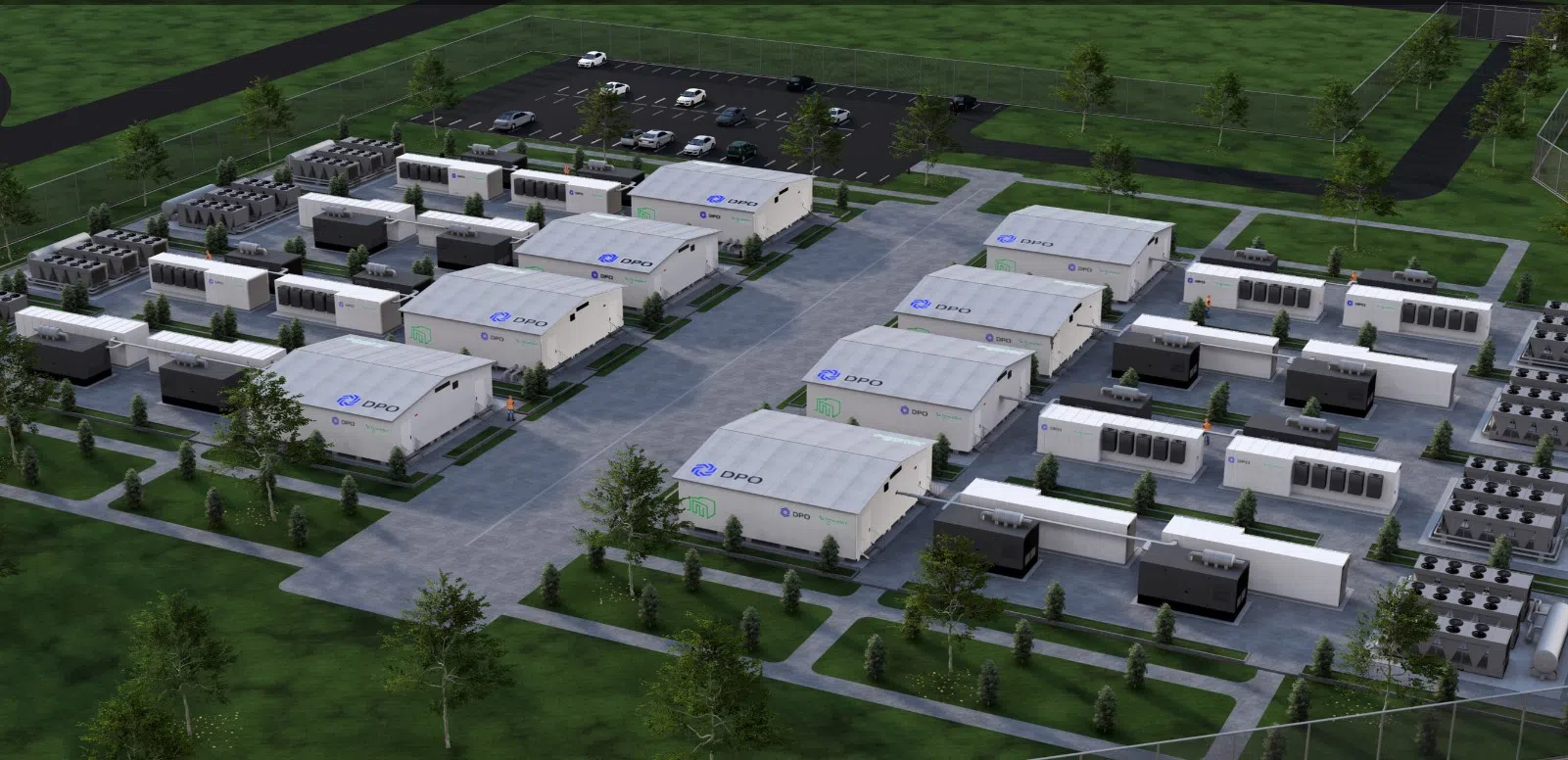
DPO Data Center rendering. Image courtesy: Digital Power Optimization, Inc.
WAUSAU, WI (WSAU) – A new study on U.S. and statewide AI Data Center regulations has uncovered how foreign governments and companies are influencing voters and local lawmakers to reject AI Data Center construction in the United States, including in Wisconsin.
According to the Bitcoin Policy Institute, a non-profit, nonpartisan think tank dedicated to advancing cryptocurrency policy through research and education, the Party for Socialism and Liberation (PSL), a far-left organization with documented ties to China, has delayed, blocked, or reduced approximately $23.6 billion in proposed AI data center investment in the United States, including four projects in Wisconsin.
The Party for Socialism and Liberation (PSL) ran more than 20 separate campaigns in 14 states, according to Sam Lyman, Head of Research at BPI. These efforts resulted in 10 data center moratoria, one permanent data center ban, and four projects that were rejected or scrapped. In Wisconsin, the PSL worked on the ground and made financial investments to help stop the construction of a $12 billion Blackstone-backed hyperscale campus in DeForest. They also used some of those same resources to increase support for the Port Washington anti-data center referendum, which was approved in April. According to Lyman, the Party is currently running at least two other campaigns in Wisconsin.
The study also shows that the PSL’s leadership, including those in charge of nonprofits like BreakThrough News and The People’s Forum, has many connections to Neville Roy Singham, a well-known ally of the Chinese Communist Party who lives in Shanghai and is currently the subject of an ongoing DOJ federal grand jury investigation in the Southern District of New York for crimes such as money laundering and bank fraud. Additionally, BPI describes how Singham and the CCP have worked together since 2021 to progressively undermine public confidence in the expansion of data centers in the US through these groups and CCP-run media sources including CGTN, China Daily, and Global Times.
This study follows OpenAI’s June 2026 report, in which users believed to be based in China and connected to the PSL and other CCP-affiliated groups used ChatGPT to generate English-language social media content and disinformation, including talking points and images, highlighting rising water and electricity costs and local disruptions caused by data centers.
These studies and reports state that China and the US are engaged in a silent war over the development of data centers and artificial intelligence, and that the PSL and other CCP-affiliated organizations are using misinformation and disinformation to keep the Trump Administration from challenging China’s expanding market and industry dominance. According to recent research, the need for artificial intelligence in China is predicted to increase by 500 times for both civilian and military purposes. As a result, the CCP has invested nearly $300 billion in creating a statewide network of computer hubs, headed by state-owned companies like China Mobile.
While some worries about data centers are legitimate, US energy chief Chris Wright said at an Amazon Web Services conference on Tuesday that many of them are “overblown” and based on false information. He added that more data centers will result in lower energy costs and that water consumption with new data centers is “tiny” in comparison to the benefits they provide. Wright continued by drawing a connection between the fracking debate in the United States during the 2010s and the data center issue.
According to the Goldwater Institute, frequent misconceptions regarding data centers include concerns about energy use and water waste. For example, current data centers use air-based or closed-loop cooling, which significantly uses less water than older open-loop systems. In addition, most states in the United States, including Wisconsin, require data centers to pay for costs such as interconnection, infrastructure upgrades, and large-load fees.
In April, the Wisconsin Public Service Commission authorized a pricing plan that sets a precedent for We Energies to demand that huge data centers bear all expenses associated with higher fuel, infrastructure, and energy-generating consumption. The policy comes after a February poll done by Marquette Law School discovered that 70% of Wisconsin voters believe data centers are more expensive than beneficial, up from 55% five months earlier.
U.S. Energy Department data states that the construction of data centers will generate millions of dollars in local tax revenue, thousands of well-paying construction jobs, and, in many cases, long-term renewable energy projects and essential workforce employment training.





Comments